Purdue researchers explore new chapter of physics
Interactions between light and matter are a fundamental unit of modern physics, but recently researchers have started to look beyond the standard textbook interactions.
Interactions between light and matter are a fundamental unit of modern physics, but recently researchers have started to look beyond the standard textbook interactions.
Researchers have discovered a new reaction mechanism that could be used to improve catalyst designs for pollution-control systems to further reduce emissions of smog-causing nitrogen oxides in diesel exhaust.
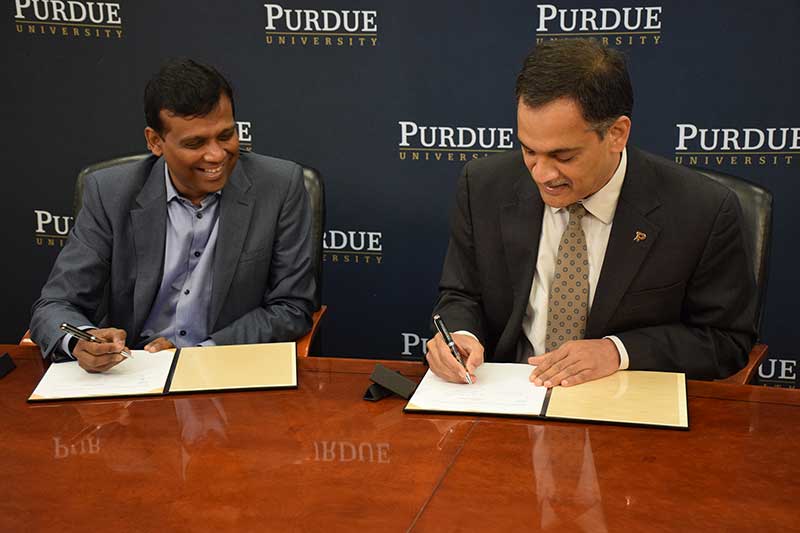
Purdue University is entering into a five-year agreement with Infosys (NYSE: INFY), a global leader in consulting, technology and next-generation services. As part of the agreement, Purdue will provide classes and training for many of the 10,000 American employees that Infosys will hire over the next two years, 2,000 of whom will be based in Indiana. Much of this training will be aimed at new employees and conducted on the West Lafayette campus, but the partnership also includes lifelong learning opportunities via specialist online courses for existing Infosys employees.
Researchers at Purdue University have successfully simulated powerful flows of plasma leaving a black hole, bringing us one step closer to understanding the complicated relationship between supermassive black holes and their host galaxies.
Thomas W. Hertel, Purdue University professor of agricultural economics, and his team aim to develop a multidisciplinary approach for managing the earth’s unowned natural resources such as the oceans, atmosphere, and space, also known as the global commons, in order to establish an applied research consortium which will analyze scenarios and explore policy alternatives. These alternatives will promote responsible public and private investment, sustainable management of critical, shared natural resources, and collective action toward meeting the United Nations’ Sustainable Development Goals.
A new featherweight, flame-resistant and super-elastic “metamaterial” has been shown to combine high strength with electrical conductivity and thermal insulation, suggesting potential applications from buildings to aerospace.
The composite combines nanolayers of a ceramic called aluminum oxide with graphene, which is an extremely thin sheet of carbon. Although both the ceramic and graphene are brittle, the new metamaterial has a honeycomb microstructure that provides super-elasticity and structural robustness.
A new type of micropropulsion system for miniature satellites called CubeSats uses an innovative design of tiny nozzles that release precise bursts of water vapor to maneuver the spacecraft.
Low-cost “microsatellites” and “nanosatellites” far smaller than conventional spacecraft, have become increasingly prevalent. Thousands of the miniature satellites might be launched to perform a variety of tasks, from high-resolution imaging and internet services, to disaster response, environmental monitoring and military surveillance.
A Purdue University study confirms complex associations among plant hormones and their signaling pathways that are key to controlling plant architecture.
Researchers have created a new type of non-liquid lubricant that has been shown to reduce friction and wear significantly under the extreme conditions found in various applications, from air compressors to missile systems.
Purdue University researchers are developing an on-site computer and software system that could provide a more flexible, high-quality and user-friendly way to conduct agriculture-based air quality research to better understand and limit emission and pollution impact.
Jiqin Ni, an associate professor, and Albert Heber, a professor, both in Purdue’s Department of Agricultural and Biological Engineering, invented the technology.